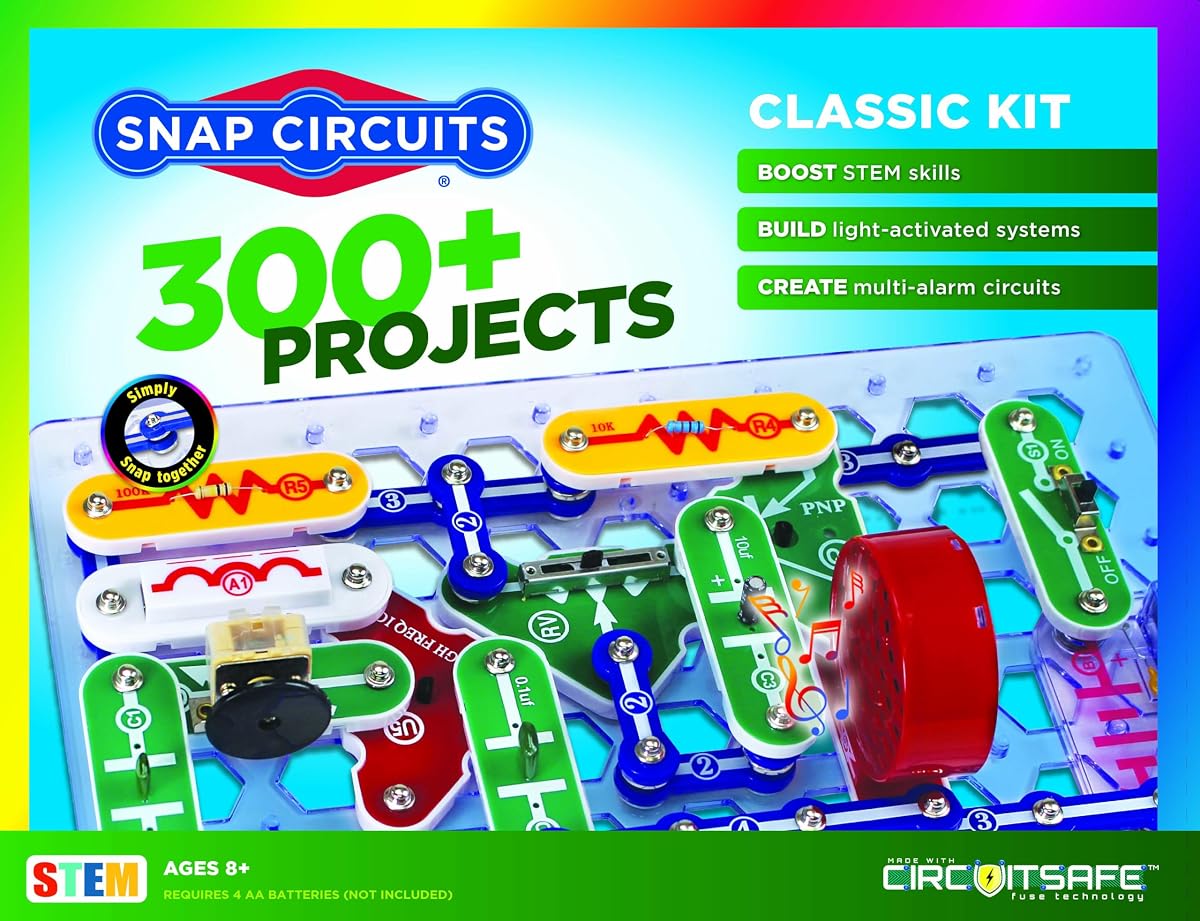
SNAP CIRCUITS Classic SC-300 STEM Electronics Kit
4.8Editor score
300+ Projects
No Tools Needed
Safe for Ages 8+
This guide compares the top electronics kits for teens to help you choose the best STEM project for learning coding, soldering, and robotics skills.
Choosing the right electronics kit for teens can spark a lifelong passion for engineering and coding. These kits provide hands-on experience with real components like sensors, motors, and microcontrollers. They transform abstract concepts into tangible projects that build confidence and technical skill.
We evaluated ten top-rated kits based on component quality, educational value, and ease of assembly. Each product offers unique learning paths from simple soldering to advanced Arduino programming. Our analysis focuses on safety, support materials, and the potential for creative expansion.
Each pick highlights specific strengths for different skill levels and interests. Prices and availability change frequently so always verify current listings before purchasing. This guide ensures you find a kit that matches your teen's current abilities and future goals.
4.8Editor score

4.7Editor score

4.5Editor score
The following table provides a side-by-side comparison of all ten selected electronics kits for teens. It highlights key specifications to help you quickly identify the best fit for your needs.


This is the most complete starter kit available for serious teen learners. It rates 4.7 stars based on thousands of verified user reviews. The standout quality is its massive array of 200+ components supporting diverse builds.
We may earn a commission when you buy through this link, at no additional cost to you.
The MEGA 2560 board offers 54 digital I/O pins and 256 KB flash memory. This supports larger builds combining many sensors, controls, and displays simultaneously. Projects include RFID access, real-time clocks, and interactive displays.
The trade-off is size and complexity compared to simpler kits. Beginners might feel overwhelmed by the sheer volume of parts. However, the organized storage box reduces setup time significantly between projects.
Buy this if your teen wants maximum potential for STEM learning and coding clubs. It turns structured exercises into real systems like monitors, alarms, and interactive displays effectively.
Includes 200+ components across many types like sensors, motors, and displays to support long-term learning.
With 54 digital pins and 4 serial ports it handles complex multi-sensor projects that simpler boards cannot.
We may earn a commission when you buy through this link, at no additional cost to you.
This classic kit introduces kids ages 8 and up to electrical engineering safely. It holds a 4.8 star rating from many parents and educators. It stands out for building cool gadgets without soldering or tools.
We may earn a commission when you buy through this link, at no additional cost to you.
Over 300 exciting projects are possible using colorful numbered pieces. You can build AM radios, doorbells, burglar alarms, and electronic games. The numbered color-coded pieces snap onto a plastic grid easily.
Since it does not include coding it is less flexible than microcontroller kits. Some teens may want to program circuits rather than just assemble them. However it is excellent for pure electronics basics.
Buy this for teens who prefer physical assembly over coding. It keeps them busy all year round and works well when combined with other Snap Circuits kits.
No tools or soldering needed make this the safest way to learn electronics quickly and safely at home.
With 300 projects you get amazing value and can build radios, alarms, and games easily from one box.
We may earn a commission when you buy through this link, at no additional cost to you.
Turn coding and engineering into a working programmable robot car with this kit. It rates 4.5 stars and is ideal for family STEM projects. The standout quality is its built-in camera for live video feed control.
We may earn a commission when you buy through this link, at no additional cost to you.
Control the car with an app or IR remote while viewing live FPV video. It tracks black lines and avoids obstacles using ultrasonic sensors. Keyed connectors reduce wiring mistakes for beginners.
The premium price and need for guidance are trade-offs to consider. Teens might struggle alone with complex setup tasks. However the learning value from building a real robot is unmatched.
Buy this for teens ready for advanced robotics challenges. It develops coding, problem-solving and engineering skills through a complete rechargeable STEM kit.
The onboard camera provides live video feedback so you can see what the robot sees in real time.
Built-in sensors enable line tracking and obstacle avoidance which are essential real-world robotics features.
We may earn a commission when you buy through this link, at no additional cost to you.
This kit supports beginners moving from lessons to original projects smoothly. It has a 4.7 rating and starts with LEDs moving toward complex sensors. The standout feature is its flexible power setup.
We may earn a commission when you buy through this link, at no additional cost to you.
It includes 200+ components across 63 types like RFID and ultrasonic sensors. A 9V power supply and battery let you run experiments without external sources. Pre-soldered modules keep setup time low.
The reliance on USB cable might limit mobile projects slightly. However the breadboard and small-parts box make it easy to find parts. It supports STEM learning and coding clubs well.
Buy this if you want a complete Arduino path without soldering initially. You can modify thresholds and timing to turn exercises into custom projects easily.
Included power supply and battery mean you do not need to buy extra accessories for initial experiments.
Pre-soldered modules let beginners focus on coding and wiring logic instead of soldering first.
We may earn a commission when you buy through this link, at no additional cost to you.
Create your own portable Bluetooth speaker with dual 3W speakers and LED lights. It is a practical gift for students and makers to build a useful device. It rates 3.9 stars for functional output.
We may earn a commission when you buy through this link, at no additional cost to you.
The board comes pre-soldered to simplify soldering for learners. You can play music via Bluetooth, TF card, or USB drive. An infrared remote control supports easy operation for everyone.
Some users report variations in Bluetooth module versions between batches. The manual updates to reflect different soldering steps needed. This requires attention to detail during assembly.
Buy this for teens who already have basic soldering knowledge. It is an ideal high school STEM project that results in a speaker they can actually use.
Unlike many kits you get a working speaker you can use in dorm rooms or bedrooms after building it.
Exploring amplifier circuits and components helps develop practical electronics skills effectively.
We may earn a commission when you buy through this link, at no additional cost to you.
Follow 22 guided lessons to make LEDs blink and move motors. This kit is ideal for family weekend builds and homeschool units. It has a 4.7 rating and focuses on logic and creation.
We may earn a commission when you buy through this link, at no additional cost to you.
Plug-in modules let you focus on wiring and code without soldering. It includes servo and stepper motors, an LCD display, and sensors. Component lists make it easier to find parts quickly.
Simpler components mean less complexity for first-time builders. You should work with an experienced adult to check polarity and power input. This ensures safety and success for younger teens.
Buy this to learn the logic behind circuits before creating your own. You can change speeds and sequences for alarms or reaction games easily.
Plug-in modules and pre-soldered LCD help beginners focus on coding rather than soldering.
The tutorial and code help you understand digital input and output basics clearly.
We may earn a commission when you buy through this link, at no additional cost to you.
Build a fully functional Bluetooth speaker with a dynamic LED light visualizer. It rates 4.7 stars and creates a vibrant light show with music. The clear acrylic enclosure displays the components beautifully.
We may earn a commission when you buy through this link, at no additional cost to you.
Every soldering step is demonstrated with high-clarity instruction photos. The kit is designed for easy assembly for hobbyists and students. It includes everything needed including the purple PCB board.
Foundational soldering experience is required so absolute beginners may struggle. If you know basics this kit is smooth to complete. The wiring connections are visually demonstrated to ensure success.
Buy this for hobbyists who want a creative visual result. It is a great soldering project for practicing skills while building a speaker.
The 10-LED light show pulses in sync with your music for an enhanced listening experience.
Step-by-step photos show every wire and component placement clearly to avoid mistakes.
We may earn a commission when you buy through this link, at no additional cost to you.
Create music by waving your hands around electric fields with this kit. It has a 4.5 rating and lets you build your own invention. It stands out for teaching electrical capacitance and science.
We may earn a commission when you buy through this link, at no additional cost to you.
Place parts in the breadboard to connect without needing soldering. The colorful instruction booklet guides you step by step with breaks to check work. Everything needed is included in the box.
Some teens may prefer more coding-heavy electronics projects over physics. This kit focuses on invention and learning rather than coding. But it is great for curiosity and science exploration.
Buy this for teens who enjoy physics and hands-on discovery. It is a unique journey from beginner to inventor for anyone with curiosity.
You learn how electrical capacitance affects sound by physically waving your hands near antennas.
The breadboard setup means you do not need to learn soldering at all.
We may earn a commission when you buy through this link, at no additional cost to you.
Add motion, distance, light, and sound functions to compatible boards. This kit is perfect for prototyping and classroom experiments. It rates 4.7 stars and focuses on sensor variety.
We may earn a commission when you buy through this link, at no additional cost to you.
Experiment with GY-521 motion sensing and ultrasonic ranging. Add displays and timing modules to build clocks and automated projects. Digital tutorial materials provide example code and diagrams.
Note that no controller board or USB cable is included. You must have a compatible UNO or Mega board already. It is an expansion kit rather than a complete system.
Buy this if you already have a basic Arduino setup. It adds input and control functions to make existing projects more interactive.
37 modules including PIR and ultrasonic let you experiment with many input types easily.
Use digital materials and example code to quickly integrate sensors into your projects.
We may earn a commission when you buy through this link, at no additional cost to you.
Build a complete electronic project with seven built-in interactive functions. It is designed for users aged 15 and above for school workshops. It rates 4.1 stars and offers three difficulty levels.
We may earn a commission when you buy through this link, at no additional cost to you.
Choose from three levels to match different experience levels. The color-printed manual and video guidance support component assembly. This helps users complete the project with clear instructions.
The specific age limit makes it unsuitable for younger teens. It also requires basic soldering skills rather than snap connectors. But it provides a structured way to practice electronics.
Buy this for supervised group learning or individual practice. It helps develop hands-on skills through making and testing effectively.
Three difficulty levels let you grow your soldering skills at a pace that suits you.
Video guidance alongside the manual makes it easier to understand assembly steps.
We may earn a commission when you buy through this link, at no additional cost to you.
Choosing the right kit depends on skill level and learning goals. Consider these factors to find the best fit.
Determine whether the teen has zero experience or some coding knowledge. Beginners benefit from solderless kits like Snap Circuits while advanced teens prefer Arduino projects.
Look for kits that offer many components like sensors and displays. More variety allows for diverse projects and longer learning engagement.
Some kits require soldering while others do not. Choose a solderless kit if the teen has no experience or a soldering kit for hands-on skills.
Microcontroller kits like Arduino include coding tutorials. If coding is a goal pick a kit with clear example code and IDE support.
Prices vary significantly between basic kits and advanced robotics. Set a realistic budget while ensuring quality components are included.
Consider if they want one-off builds or expandable systems. Expansion kits are great for future projects while complete kits are best for first builds.
Safety is paramount especially for younger teens. Choose kits with clear age recommendations and safe battery or power handling.
High-quality manuals and online resources reduce frustration. Look for kits with clear wiring diagrams and step-by-step instructions.
Always read the instruction manual before assembly. Follow all safety guidelines regarding batteries and tools to prevent injury.
Store components in the provided storage case after each session. This prevents losing small parts and keeps the workspace organized.
Charge batteries properly and disconnect them when not in use to extend their lifespan and ensure safety.
Most kits are suitable for ages 8 and up. More complex Arduino kits recommend teens aged 12 and up with adult guidance. Always check the product age rating.
No many starter kits are solderless and use breadboards. However soldering kits are available for teens ready to learn those skills. Choose based on their experience.
Yes most kits include PDF guides and example code in Arduino IDE. These tutorials explain digital input and output for beginners. Some kits even provide online video resources.
Yes many kits like the 37-in-1 Sensor Kit are designed for expansion. You can add more modules or components to create new interactive systems easily.
Most kits use USB power or 9V batteries. Some include power supplies while others require you to purchase them separately. Check the product specs before buying.
Simple projects can take 30 minutes while complex builds take several hours. Time depends on experience level and project complexity. It is often a multi-week process.
Yes supervision is recommended especially for younger teens and complex kits. Adults can help with wiring and safety checks. It also allows for learning together.
We recommend the ELEGOO Mega 2560 R3 for maximum learning potential. It offers extensive components and advanced capabilities for long-term projects.
Prioritize safety and skill matching when picking a kit. Solderless kits are best for beginners while Arduino kits suit advanced learners.
Always check current prices and availability before buying. These kits often fluctuate so verify details to ensure the best value.