
2pcs AHT30 High Precision Digital Temperature and Humidity Sensor
5.0Editor score
I2C communication
Low power consumption
High accuracy
This comprehensive guide compares the top ten Arduino temperature sensors available in October 2026 based on accuracy, connectivity, price, and ease of use for
Selecting the right temperature sensor for your Arduino projects can significantly impact the reliability and accuracy of your final build. Whether you are monitoring indoor climate conditions or tracking industrial machinery heat, finding a compatible and robust sensor is essential for consistent performance.
We have evaluated ten leading temperature sensors specifically designed for seamless integration with Arduino boards and other microcontrollers. Our comparison focuses on critical factors such as measurement range, communication protocol, waterproofing capabilities, and overall value for DIY enthusiasts and professionals.
Each selection in this guide highlights unique strengths and potential limitations to help you make an informed decision for your specific application. Please note that product availability and pricing may fluctuate over time, so verify current details before finalizing your purchase.
5.0Editor score

4.5Editor score

4.4Editor score
The following table provides a side-by-side comparison of all ten selected temperature sensors. It outlines their key specifications, operating voltages, measurement ranges, and unique features to assist in quick decision-making.



The HiLetgo 5pcs DHT11 module stands out as a reliable choice for those starting with temperature and humidity monitoring on Arduino. With a 4.5 rating and a robust design that includes a bypass capacitor and pull-up resistor, it minimizes wiring complexity.
We may earn a commission when you buy through this link, at no additional cost to you.
Its single-wire communication protocol greatly reduces the programming effort required, making it accessible for hobbyists. The module is pre-calibrated and features a fully interchangeable design, ensuring stable long-term performance within its specified measurement ranges.
While the temperature range is limited to 0 to 50 degrees Celsius, this suffices for most indoor applications. The accuracy is adequate for general monitoring, though precise industrial control may require higher-grade alternatives.
This kit is ideal for educational projects, home automation, and environmental monitoring where cost and ease of use are priorities. Its comprehensive packaging ensures you have everything needed to begin testing immediately.
The included bypass capacitor and pull-up resistor simplify circuit design, allowing for quick connection to microcontroller IO ports without additional components.
Outputting a clean digital signal rather than analog voltage ensures stable data transmission, reducing noise issues common in long wiring setups.
We may earn a commission when you buy through this link, at no additional cost to you.
The AHT30 module offers exceptional precision with an accuracy of ±0.3 degrees Celsius, making it suitable for demanding applications. Its perfect 5.0 rating reflects user satisfaction with its performance and reliability in various environments.
We may earn a commission when you buy through this link, at no additional cost to you.
This sensor supports I2C communication, allowing simultaneous online access to multiple devices on the same bus. This feature is valuable for projects requiring multiple sensors without consuming excessive GPIO pins.
The wide voltage range from 2.0V to 5.5V ensures compatibility with a broad array of microcontrollers. Low power consumption further enhances its utility in battery-powered IoT applications.
If you seek accurate readings without a high price tag, this module is an excellent choice. It is particularly well-suited for smart home devices and climate control systems where data fidelity matters.
With a temperature resolution of 0.01 degrees Celsius, the AHT30 provides granular data ideal for precise environmental monitoring tasks.
Supporting I2C master output simplifies wiring and enables efficient data transfer, reducing latency in multi-sensor configurations.
We may earn a commission when you buy through this link, at no additional cost to you.
The Gikfun DS18B20 kit is designed for environments where water resistance is critical. Its waterproof probe allows deployment in fish tanks, greenhouses, and machinery where moisture is present.
We may earn a commission when you buy through this link, at no additional cost to you.
Each set includes a pluggable adapter board with a pull-up resistor, simplifying connections to microcontrollers. The 1 meter lead length provides flexibility in placement without needing extensions.
With a temperature range spanning from -55 to 125 degrees Celsius, this sensor handles extreme conditions. The digital one-wire interface ensures reliable communication even over longer distances.
This product is perfect for industrial systems, thermostatic controls, and consumer products requiring rugged durability. Its robust construction guarantees longevity in challenging operational settings.
The stainless steel probe with thermally conductive sealant ensures accurate readings even when submerged in water or exposed to steam.
The adapter module supports direct connection to most microcontrollers, making it widely used in diverse monitoring applications.
We may earn a commission when you buy through this link, at no additional cost to you.
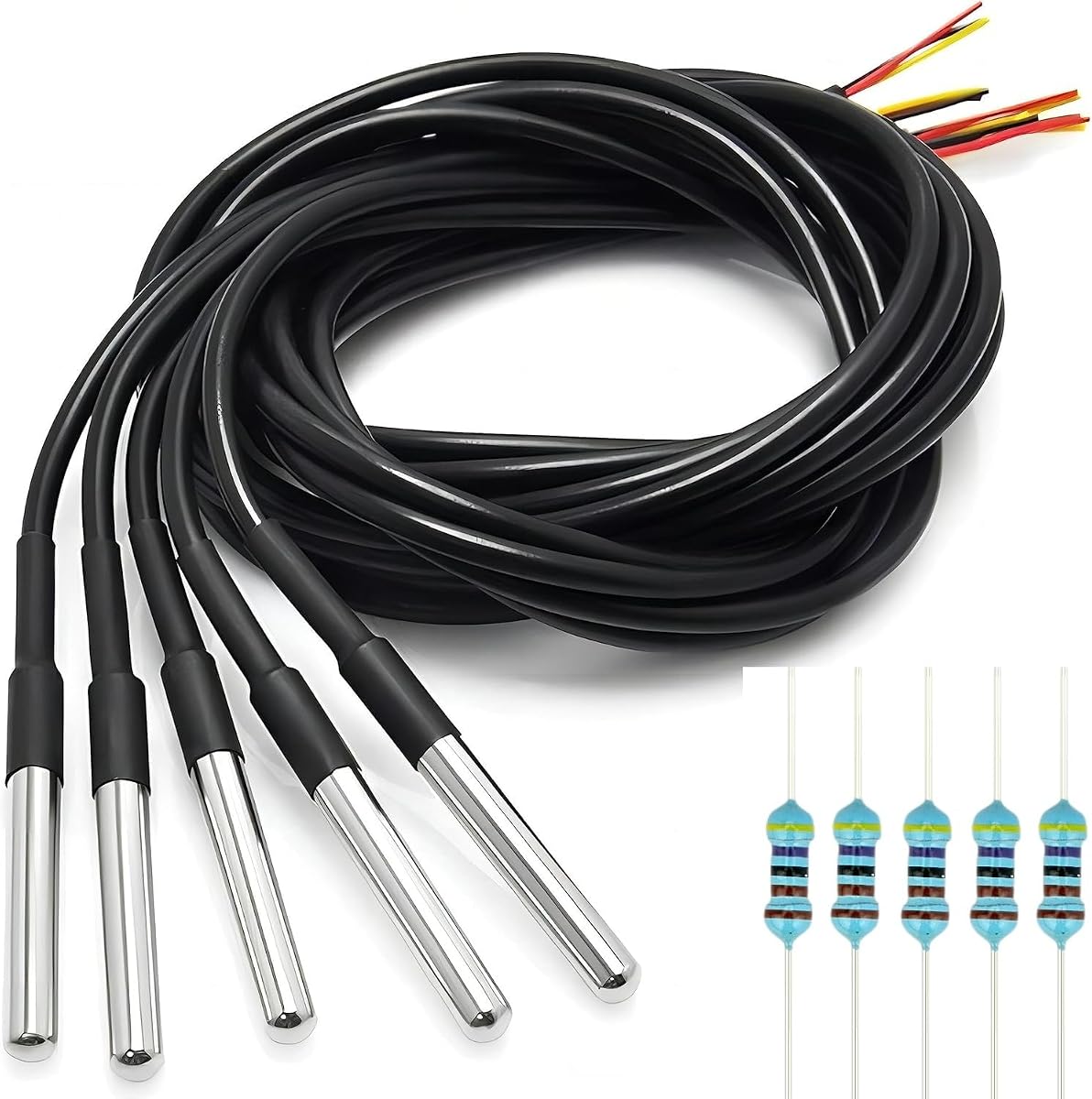
This kit from WWZMDiB provides five DS18B20 sensors along with necessary resistors, offering great value for larger builds. The probes are designed for underwater use, ensuring they withstand wet or moist environments without damage.
We may earn a commission when you buy through this link, at no additional cost to you.
The wide temperature range and high accuracy make it suitable for precise thermal monitoring. Its compatibility with various platforms like Arduino and Raspberry Pi enhances its versatility.
Wiring is straightforward with color-coded leads for VCC, Data, and GND. The inclusion of resistors simplifies setup, reducing the need for additional components.
Ideal for users managing multiple temperature points or building sensor arrays, this kit balances performance and cost. It is a practical solution for both hobbyist and professional projects.
Having five resistors included in the package saves time and money, allowing immediate connection without sourcing extra parts.
The waterproof design ensures the sensors function correctly even when fully submerged, making them ideal for aquatic monitoring.
We may earn a commission when you buy through this link, at no additional cost to you.
This 2-pack of DHT11 modules offers an economical way to monitor temperature and humidity in multiple locations. It utilizes a dedicated digital module to ensure high reliability and excellent long-term stability.
We may earn a commission when you buy through this link, at no additional cost to you.
The single-wire wiring scheme makes it easy to integrate into various applications. Its simple communication protocol reduces the programming effort required for data retrieval.
Operating voltage between 3.3V and 5V ensures compatibility with most common development boards. The included wires facilitate a quick start for your projects.
Recommended for basic climate monitoring and educational setups, this product provides solid performance at a low cost. It is a practical choice for users needing duplicate sensors.
Monitoring two areas simultaneously allows for differential analysis and more comprehensive environmental data collection.
The sensor's resistive element and NTC technology ensure consistent readings over time without frequent recalibration.
We may earn a commission when you buy through this link, at no additional cost to you.
The DROK kit stands out for its completeness, offering probes, adapter boards, wires, and resistors. This makes it ideal for beginners who want everything needed to start measuring temperature immediately.
We may earn a commission when you buy through this link, at no additional cost to you.
Its high accuracy and wide temperature range make it suitable for demanding applications. The stainless steel probe ensures durability in wet or corrosive environments.
The adapter board features an integrated pull-up resistor, enabling direct connection to GPIOs without external components. This simplifies wiring and reduces potential points of failure.
This package is perfect for users who value convenience and reliability. Whether for industrial systems or DIY climate control, it delivers consistent and precise results.
Having every necessary component in one package saves time sourcing parts and ensures compatibility between items.
The rustproof stainless steel casing protects the sensor from harsh conditions, extending its operational lifespan significantly.
We may earn a commission when you buy through this link, at no additional cost to you.
This set of five DS18B20 sensors is designed for extensive monitoring needs. The waterproof feature and long lead length make it versatile for various installations.
We may earn a commission when you buy through this link, at no additional cost to you.
Each probe operates within a wide voltage range and offers digital output for reliable data. The one-meter length provides flexibility in positioning sensors far from the microcontroller.
While external resistors are needed for optimal stability, the digital bus interface minimizes wiring complexity. This allows for connecting multiple sensors on a single pin.
Ideal for thermostatic controls or industrial systems, this product supports scalable temperature monitoring. It balances functionality with ease of deployment for large projects.
The one-meter cable allows you to place sensors in hard-to-reach areas without needing additional extensions.
With five probes included, you can cover multiple zones efficiently, making it cost-effective for expansive projects.
We may earn a commission when you buy through this link, at no additional cost to you.
The DHT22/AM2302 module improves upon the DHT11 with better accuracy and wider range. Its high-sensitivity chip ensures precise humidity measurements critical for environmental control.
We may earn a commission when you buy through this link, at no additional cost to you.
With a temperature range from -40 to 80 degrees Celsius, it covers more scenarios than the basic DHT11. Bidirectional serial data communication enhances stability in data exchange.
The inclusion of fixing screw holes allows for secure installation, preventing movement that might affect readings. It serves as an excellent replacement for older SHT models.
Best suited for applications requiring reliable humidity data, this sensor is a smart upgrade for smart home or greenhouse projects. Its robust design ensures consistent performance.
The AOSONG AM2302 chip offers high sensitivity to ensure accurate humidity tracking even in varying environmental conditions.
Fixed mounting holes make the module secure in place, reducing vibration risks that could affect sensor stability.
We may earn a commission when you buy through this link, at no additional cost to you.
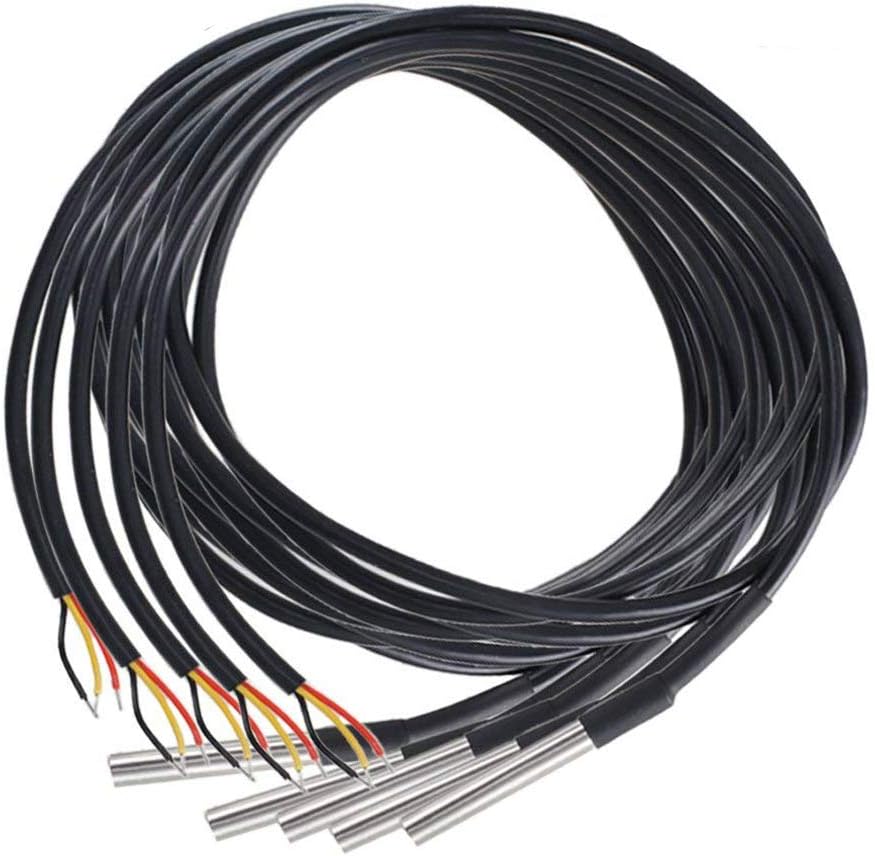
This five-pack offers significant value for users needing multiple temperature points. Each probe features a waterproof stainless steel package suitable for harsh or wet environments.
We may earn a commission when you buy through this link, at no additional cost to you.
With a wide temperature range, these sensors can handle extreme cold or heat. The single bus interface allows easy connection of multiple probes to one data line.
The simplicity of wiring, using red, yellow, and black leads, makes assembly straightforward. Adding a 4.7K resistor between Data and VCC aids in testing stability.
For large-scale projects like server room monitoring or agricultural systems, this kit provides the necessary components efficiently. It balances cost with performance well.
Having five sensors in one package reduces per-unit cost, making large projects more budget-friendly.
The straightforward three-wire connection scheme simplifies setup, allowing quick deployment across multiple locations.
We may earn a commission when you buy through this link, at no additional cost to you.
The Teyleten SHT31-D module features a wide voltage range, making it compatible with various power sources. Its high accuracy ensures reliable data for precise environmental monitoring.
We may earn a commission when you buy through this link, at no additional cost to you.
With humidity measurement from 0 to 100% RH, it covers the full spectrum of possible conditions. The I2C interface allows efficient communication on shared buses.
The three-pack provides redundancy and flexibility for larger setups. This ensures you can deploy sensors in multiple critical zones without additional purchasing.
Ideal for projects requiring high fidelity and stable performance, this sensor is a strong contender for professional applications. Its design supports robust and continuous operation.
Operating from 2.4V to 5.5V DC allows connection to different microcontrollers and battery configurations easily.
The ±0.3 degree Celsius accuracy ensures trustworthy data, crucial for precise control systems and environmental research.
We may earn a commission when you buy through this link, at no additional cost to you.
Selecting the right temperature sensor involves balancing accuracy, connectivity, environmental requirements, and cost.
Accuracy determines how close the sensor reading is to the actual temperature. High-resolution sensors are vital for applications needing precise control, such as climate regulation or scientific experiments.
Look for sensors with accuracy within ±0.5 degrees Celsius for general use and ±0.3 for specialized tasks.
Most Arduino projects operate at 3.3V or 5V. Ensure your sensor supports these voltages to avoid additional regulators. Lower power consumption is essential for battery-operated devices.
Choose sensors that work within your microcontroller's voltage range to simplify circuit design and reduce power issues.
Common protocols include Single Wire, I2C, and SPI. I2C allows multiple devices on two wires, reducing pin usage. Single Wire like DS18B20 is simple but slower.
Select a protocol that fits your pin availability and data transmission needs.
Consider whether the sensor needs to be waterproof or resistant to dust and corrosion. Stainless steel probes are ideal for wet or industrial conditions.
Waterproof sensors protect hardware and ensure reliability in outdoor or high-moisture environments.
Sensors vary from limited indoor ranges to broad industrial spans. Ensure the sensor covers the lowest and highest temperatures you expect to encounter.
A wide range provides flexibility for diverse applications without risking sensor damage.
Sensors with built-in pull-up resistors or modules simplify wiring. Kits including resistors and wires save time and reduce errors.
Preferring modular designs accelerates development and minimizes wiring complexity.
Buying in bulk can reduce costs when you need multiple sensors. Five-packs often provide better value than single units.
Consider your project scale to decide if multi-sensor packs make economic sense.
Popular sensors often have extensive libraries and community forums. This support simplifies coding and troubleshooting.
Check for available Arduino libraries to ensure smooth software integration and faster deployment.
Begin by connecting the sensor to your Arduino board, ensuring proper voltage connections. Use color-coded wires (red for power, black for ground, yellow for data) to avoid errors.
Install the appropriate library via the Arduino IDE. Most common sensors like DHT and DS18B20 have standard libraries available. Upload a basic example code to test sensor functionality.
Calibrate the sensor using a known reference thermometer. Place both sensors side by side in a stable environment to verify readings. Periodically clean the probe to ensure accuracy.
Digital sensors provide direct digital output, simplifying code and reducing noise. Analog sensors require conversion and are more prone to interference. Most modern sensors are digital for reliability.
Many DS18B20 sensors require a 4.7K pull-up resistor on the data line. Some modules come with built-in resistors, while others do not. Always check the product specifications before wiring.
Waterproof DS18B20 sensors are ideal for outdoor deployment due to their stainless steel housing. They resist moisture and corrosion, ensuring durability in varied weather conditions.
Yes, using a 1-wire or I2C protocol, multiple sensors can share a single pin. Each sensor has a unique address to prevent data conflicts on the bus.
Accuracy typically ranges from ±0.5 to ±0.3 degrees Celsius. High-end models like the AHT30 offer better precision, while budget DHT11 sensors are sufficient for general monitoring.
Popular libraries include Adafruit DHT, OneWire, and DallasTemperature. These simplify code by handling communication protocols and data conversion automatically.
This guide covered ten top-rated sensors, each with unique strengths. The HiLetgo DHT11 and AHT30 modules are excellent for accuracy and ease of use respectively.
Consider your project's environmental needs and budget. Waterproof options like the DS18B20 are best for industrial or outdoor scenarios, while digital modules suit indoor applications.
Always verify current pricing and availability before purchasing. Selecting the right sensor now ensures reliable performance and fewer complications during your project development.