
6-Band Signal Generator
100KHz to 150MHz range
Low phase noise output
Simple front panel controls
An Amfm Signal Generator is a critical tool for engineers and hobbyists who need precise control over signal frequencies and modulation types. These devices allow users to create stable waveforms for testing radio equipment, circuits, and communication systems effectively.
We compared ten leading models based on frequency range, modulation capabilities, display quality, and portability. Each product was evaluated for its ability to deliver consistent results across various testing environments, from educational labs to industrial maintenance tasks.
Every pick highlights key strengths and potential limitations to help you make an informed decision. Please note that availability and specific model features may vary over time, so always verify current specifications before purchasing.

5.0Editor score

5.0Editor score
As an Amazon Associate we earn from qualifying purchases.
The following comparison table provides a side-by-side overview of all ten models, highlighting their core specifications and unique features to streamline your selection process.




The UNI-T UTG962E stands out as a top contender for anyone needing a versatile Amfm Signal Generator. With a 60 MHz frequency range and dual channel support, it offers robust capabilities for complex testing scenarios.
We may earn a commission when you buy through this link, at no additional cost to you.
Its ability to handle AM, FM, and PM modulation types ensures compatibility with various radio frequency applications. The 200 MS/s sample rate provides high precision, making it suitable for advanced waveform generation tasks.
While it offers excellent performance, users focused solely on lower frequency industrial signals might find the feature set more than they need. The compact design adds to its appeal but may require careful handling in field environments.
This model is ideal for electronics enthusiasts and professionals requiring a balance of performance and portability. Its comprehensive modulation options make it a reliable choice for diverse RF testing requirements.
The device supports AM, FM, and PM modulation, allowing for precise signal shaping needed in communication system testing.
Its mini palm-sized form factor ensures it is easy to transport for field work or mobile lab setups.
We may earn a commission when you buy through this link, at no additional cost to you.
The OWON DGE2035 is a strong competitor for educational and lab environments. It provides a solid 35 MHz frequency range with high resolution for accurate signal reproduction. The color LCD screen improves usability during complex adjustments.
We may earn a commission when you buy through this link, at no additional cost to you.
With 150 built-in arbitrary waveforms and support for AM, FM, and FSK modulation, it covers a wide range of testing needs. The ability to control the device via PC adds significant value for automated test setups.
Some users may find the frequency limit a constraint for higher RF applications. The resolution is excellent, but the sample rate is modest compared to premium models.
This generator is perfect for students and engineers needing reliable waveform generation without extreme RF requirements. Its user-friendly interface ensures quick setup for various experiments.
14-bit resolution ensures precise signal generation, reducing noise and improving test accuracy for sensitive electronics.
USB control allows for remote operation, which is useful for long-term testing or automated laboratory workflows.
We may earn a commission when you buy through this link, at no additional cost to you.
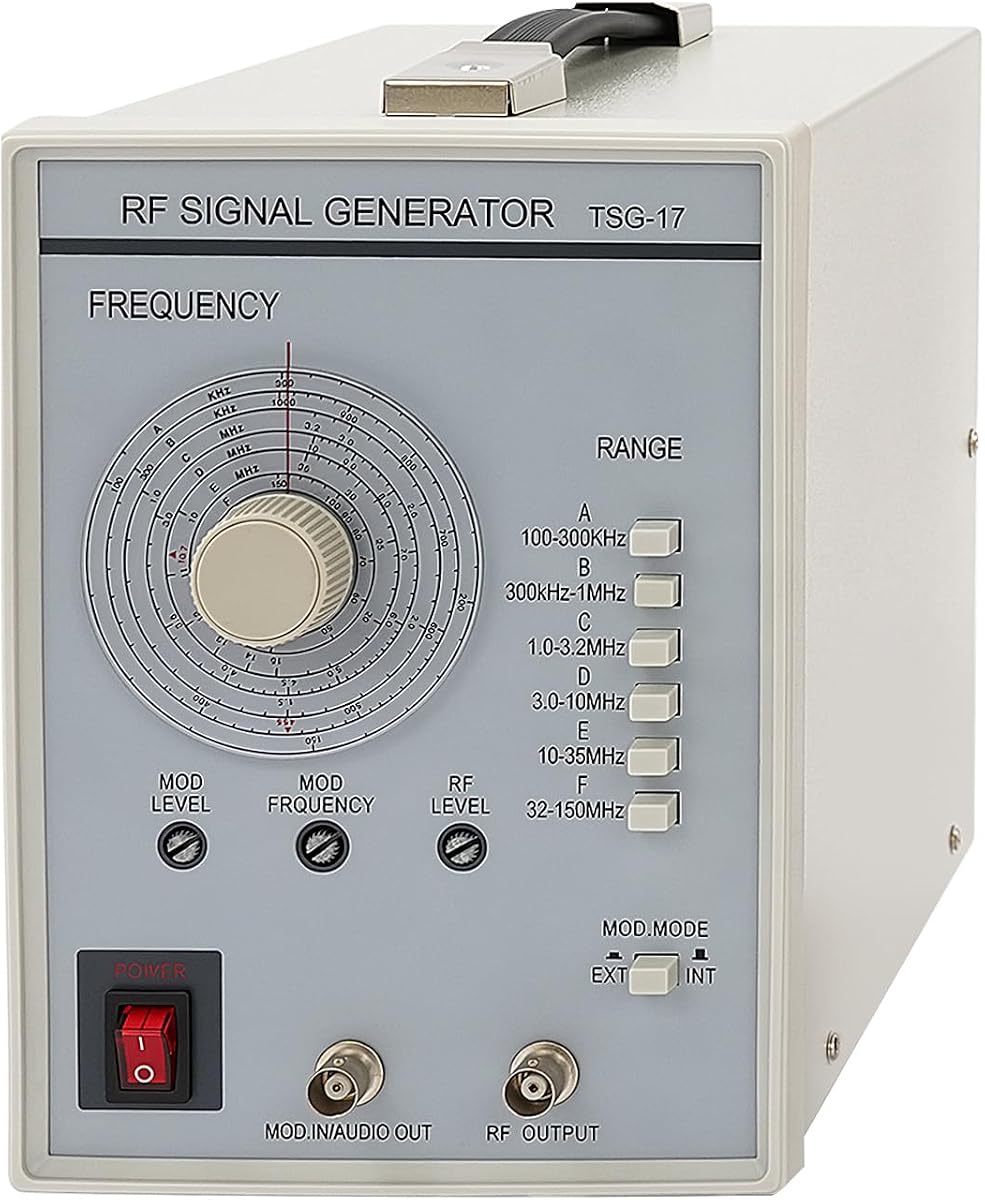
This 6-Band Signal Generator offers a budget-friendly solution for basic radio testing needs. It covers a wide frequency range from 100KHz to 150MHz, making it suitable for AM/FM receiver diagnostics. The low phase noise ensures cleaner signals for more accurate results.
We may earn a commission when you buy through this link, at no additional cost to you.
The sturdy metal and plastic construction makes it durable for workshop environments. Assembly is unnecessary, as it comes ready to use with simple knob controls. This simplicity reduces the learning curve for new users.
However, it lacks advanced modulation features found in more expensive units. Users requiring complex waveform shapes or digital modulation may find it limiting for professional R&D work.
For hobbyists and maintenance technicians needing a straightforward RF source, this device delivers excellent value. Its robust build and straightforward operation make it a reliable workhorse for basic frequency tasks.
Constructed with high-class metal and plastic, this generator is designed to withstand frequent handling and workshop conditions.
With 6 frequency ranges up to 150MHz, it provides flexibility for various radio equipment maintenance and testing scenarios.
We may earn a commission when you buy through this link, at no additional cost to you.
This unit distinguishes itself with an ultra-wide frequency range extending up to 4400MHz, far beyond standard audio or base RF generators. It is designed for users needing high-frequency testing for specialized RF modules. The memory retention saves previous settings for quick reuse.
We may earn a commission when you buy through this link, at no additional cost to you.
Power flexibility is a key advantage, as it can run on mobile chargers or computer USB. The screen kit allows for precise frequency tuning. However, the output is limited to sine waves, which restricts waveform versatility.
The description notes some noise in the wave, which may affect high-fidelity testing. Users needing clean signal quality for sensitive applications should verify signal purity before critical use.
This generator is best suited for hobbyists exploring high-frequency bands without heavy investment. Its wide range and power flexibility offer a unique niche in the budget RF tool category.
Coverage from 35MHz to 4400MHz allows testing of advanced wireless modules that require very high frequency signals.
Power-off memory ensures your frequency settings are preserved, saving time when resuming work after power loss.
We may earn a commission when you buy through this link, at no additional cost to you.
The TSG-17 is a high-frequency generator designed for commercial and household use. It covers 100kHz to 150MHz with an output that includes harmonics up to 450MHz. This broad range supports testing of various radio frequency components effectively.
We may earn a commission when you buy through this link, at no additional cost to you.
It features high accuracy settings and amplitude modulation output. The 110V power requirement means it is best suited for stationary lab environments rather than field work. Users should ensure stable power sources for optimal performance.
Reviews suggest varying performance consistency, so users should test the unit thoroughly upon arrival. The fixed power cord limits portability but ensures steady operation during long experiments.
This model is appropriate for labs requiring specific harmonic outputs for RF testing. Its design prioritizes stability over portability, making it a fixed bench instrument for specific commercial tasks.
The ability to produce harmonics up to 450MHz allows for testing components that respond to higher frequency multiples.
Designed with high accuracy in mind, this generator aims to provide precise signal levels for reliable testing results.
We may earn a commission when you buy through this link, at no additional cost to you.
This generator focuses on industrial process control signals rather than RF. It provides adjustable 4-20mA current and 0-12V voltage outputs, essential for PLC and sensor testing. The built-in lithium battery ensures portability for field calibrations.
We may earn a commission when you buy through this link, at no additional cost to you.
PWM output adds versatility for testing frequency-based controllers. Short circuit protection safeguards connected devices during testing. The device allows you to store values even when powered off for consistent setups.
It lacks the radio frequency capabilities of other models, making it specialized for analog signal simulation. Users needing RF modulation should look elsewhere, but for current loops this is highly efficient.
Ideal for technicians maintaining industrial automation systems. Its battery operation and protection features ensure reliable performance when troubleshooting control panels in various locations.
Supports 4-20mA current loops, a standard for industrial instrumentation and process control systems.
Built-in lithium battery allows for up to 5 hours of operation without access to mains power.
We may earn a commission when you buy through this link, at no additional cost to you.
The Riiai 0-10V is a compact generator designed for voltage and current simulation. It offers precision of 0.01V and 0.01mA, making it suitable for calibrating sensitive instruments. The 4-digit display ensures clear visibility of output values.
We may earn a commission when you buy through this link, at no additional cost to you.
It includes short circuit and reverse connection protection for safety during field work. You can set 9 fast signal output points for quick testing scenarios. The micro USB port allows for convenient recharging.
It is limited to low voltage and current signals, excluding RF modulation. While powerful for analog tasks, it cannot generate frequency modulation like AM or FM required for radio testing.
Best for maintenance workers and technicians needing a reliable analog signal source. Its precision and safety features make it a valuable addition to any industrial toolkit.
Precision of 0.01V and 0.01mA allows for exact adjustments needed during high-fidelity instrument calibration.
Short circuit and reverse connection protection prevent damage to both the generator and connected test equipment.
We may earn a commission when you buy through this link, at no additional cost to you.
This Riiai model offers advanced features for PLC testing with multiple signal types including current voltage and pulse. The real-time curve display helps visualize changes in signal over time. Its TFT color screen enhances user interaction and visibility.
We may earn a commission when you buy through this link, at no additional cost to you.
A 3000mAh battery supports up to 26 hours of work, making it excellent for long maintenance shifts. Programmable outputs with auto rise and fall modes simplify testing workflows. The device is robust and built for industrial use.
While it lacks RF capabilities, it excels at analog simulation. Users needing to simulate sensor data will find the real-time curve feature highly beneficial for troubleshooting complex systems.
Ideal for industrial engineers who require detailed signal simulation. The long battery life and color display make it a top-tier tool for professional maintenance tasks.
Real-time curve display allows users to monitor signal changes dynamically during testing cycles.
3000mAh battery supports up to 26 hours of operation, reducing downtime during extended field work.
We may earn a commission when you buy through this link, at no additional cost to you.
The DROK generator is a straightforward analog simulator for current and voltage. It uses a multi-cycle precise potentiometer for adjustment, which simplifies operation for quick tasks. Its dual signal capability allows flexibility for different testing needs.
We may earn a commission when you buy through this link, at no additional cost to you.
It is designed for PLC and panel debugging, making it useful for basic control system checks. The unit is compact and easy to carry. While it lacks advanced digital features, it fulfills its core purpose efficiently.
Users looking for sophisticated waveform shapes will find it limited. It is strictly an analog tool for standard industrial signals. Simplicity is its greatest strength, allowing for immediate use without complex configuration.
This generator is perfect for entry-level technicians needing a reliable tool for basic analog signal checks. Its affordability and ease of use make it a practical choice for maintenance kits.
A multi-cycle precise potentiometer allows for quick and accurate adjustment without complex digital menus.
The compact design ensures it fits easily into pockets or toolboxes for convenient transport to testing sites.
We may earn a commission when you buy through this link, at no additional cost to you.
The SEESII Dual Channel is a premium tool offering fully independent channels for complex circuit testing. With 14-bit resolution and low distortion, it ensures precise and repeatable results. It integrates seven instruments into one device, saving desktop space.
We may earn a commission when you buy through this link, at no additional cost to you.
The 60 built-in arbitrary waveforms and precise pulse width adjustment make it highly versatile. The 2.4-inch TFT LCD provides clear visualization of parameters. It is designed for rigorous R&D and engineering inspection tasks.
Its high price reflects its advanced capabilities. Users requiring basic RF output may find it overkill. However, those needing precise pulse and frequency control will appreciate the level of detail it provides.
Ideal for research labs and universities demanding high-performance testing. Its precision and multifunctionality make it a standout choice for professional electronics design and maintenance.
Two equal-performance channels allow for independent parameter adjustment, essential for differential circuit testing.
14-bit resolution produces low-distortion signals that ensure high test accuracy for precise engineering work.
We may earn a commission when you buy through this link, at no additional cost to you.
Selecting the right Amfm Signal Generator depends on your specific testing requirements and budget. Below are the key factors to consider before making your decision.
Determine the maximum frequency you need for your applications. Basic models cover up to 150MHz, while advanced units can reach several GHz for RF and microwave testing. Ensure the range aligns with your typical test components to avoid purchasing capabilities you do not need.
Look for generators that support AM, FM, and PM modulation if you are testing communication systems. Some units also support FSK and other digital modulation types. Verify that the specific modulation methods required for your work are included in the device features.
Single channel units are sufficient for simple tasks, but dual channel models allow for differential testing and phase comparisons. If you need to test two signals simultaneously or compare phases, a dual channel generator provides significant flexibility.
Higher bit resolution such as 14-bit ensures precise signal generation with lower noise. Frequency accuracy is also vital for applications requiring strict adherence to specific frequencies. Check the specifications for accuracy tolerances to ensure reliability.
If you need to use the device in the field, a battery-powered model with a compact form factor is essential. Stationary units may offer more power but lack mobility. Consider battery life and charging options like USB for extended field work.
Modern generators often feature TFT LCD screens and PC connectivity for easier operation and automation. Evaluate if you need a screen for quick visual feedback or if a PC interface is required for automated test sequences in a lab.
Durability is important for workshop environments. Look for metal housings and protective features like short circuit and reverse connection protection. A robust build ensures the device can withstand daily use and accidental mishaps.
For advanced testing, the ability to create custom arbitrary waveforms is beneficial. Generators with built-in waveform libraries allow you to simulate complex signals without external software. Check the memory depth and waveform options available.
Store the generator in a dry and temperature-stable environment to prevent electronic damage. Avoid extreme temperatures and humidity that can affect battery life and internal components. If the unit has a battery, allow it to discharge partially before long storage periods.
AM stands for Amplitude Modulation, which varies the signal strength while keeping frequency constant. FM stands for Frequency Modulation, which varies the frequency while keeping signal strength constant. Both are essential for testing different types of radio communication systems.
For simple tasks like checking a single circuit path, a single channel unit is sufficient. Dual channel generators are more beneficial if you need to compare phase differences or test balanced differential circuits simultaneously.
Yes, many modern models include built-in rechargeable batteries for portable operation. Check the specific battery life to ensure it meets your field work requirements. Some units can also run via USB or power bank for extended use.
An arbitrary waveform allows you to create custom signal shapes beyond standard sine or square waves. This is useful for simulating specific real-world signals or complex data patterns in electronic testing and research.
Use appropriate cables such as BNC coaxial cables to connect the output to your circuit input. Ensure the impedance matches to prevent reflections. If your circuit expects high impedance, use a termination resistor if needed.
Many models support USB control via software on a computer. This allows for remote operation and automated testing sequences. Check the manufacturer's website for compatible software and drivers before purchasing.
Remember that product availability and specifications can change. Always verify the latest details on the product page before finalizing your purchase.