
M-AUDIO Keystation 88 MK3
4.5Editor score
Plug and play USB connectivity
88 velocity sensitive semi weighted keys
Slimline design fits any studio
This expert guide compares the top 88 key weighted MIDI controllers for music production, detailing features, key action, and integration to help you choose
Finding the right 88 key weighted MIDI controller is essential for serious music producers and performers. These keyboards offer a realistic piano feel that enhances expression and control during recording or live sessions. Whether you need full hammer action or semi-weighted keys, the right choice impacts your workflow significantly.
We evaluated ten top models based on key action quality, software integration, build durability, and control layout. Our analysis covers essential features like aftertouch, assignable controls, and DAW compatibility to ensure each pick meets professional standards. This list includes options for various budgets and production needs.
Each review highlights specific strengths and trade-offs to help you match a controller to your studio setup. Prices and availability can change quickly so always verify current details before purchasing. Use this guide to find a reliable tool that supports your creative process for years to come.
4.5Editor score

4.6Editor score

4.3Editor score
This side-by-side comparison highlights the core specifications of each controller to help you identify the best fit for your studio setup and production style.



The Novation Launchkey 88 [MK3] stands out for its seamless integration with major digital audio workstations. It holds a strong 4.6 rating from users who appreciate its ability to map controls instantly to software parameters. This controller bridges the gap between hardware performance and software production.
We may earn a commission when you buy through this link, at no additional cost to you.
Its premium full-size keybed offers 88 semi-weighted keys that provide a comfortable playing experience for extended sessions. The 16 velocity-sensitive pads support beat production and clip launching while the arpeggiator opens up new melodic possibilities. Scale and Chord modes simplify composition for producers of all skill levels.
While the semi-weighted action is smooth, some players might prefer a heavier hammer feel for authentic piano simulations. Additionally, external hardware control requires custom mapping rather than automatic presets. These trade-offs are minimal given the robust software tools included with the unit.
Producers working primarily in a DAW environment should consider this controller for its deep integration capabilities. It is an excellent choice for those who want to streamline their workflow with minimal setup. The feature set supports creative expansion whether you are composing or arranging tracks.
Instant access to transport controls and parameter mapping simplifies your production workflow significantly.
Trigger complex chords and scales with a single finger to accelerate songwriting and arrangement.
We may earn a commission when you buy through this link, at no additional cost to you.
The M-AUDIO Keystation 88 MK3 offers a reliable entry point into 88 key MIDI control with a 4.5 rating. It focuses on essential functionality for music production without unnecessary complexity. Users appreciate its immediate plug-and-play setup which works reliably on both Mac and PC.
We may earn a commission when you buy through this link, at no additional cost to you.
With 88 full-size velocity-sensitive semi-weighted keys this controller provides a comfortable range for playing virtual instruments. The included transport buttons and pitch wheels allow for expressive performances during recording. It is designed to fit seamlessly into any desk or studio setup due to its slim profile.
The lack of a heavy hammer action may limit expressive dynamics compared to higher-end models. Furthermore control surface controls are limited to volume and transport which requires software mapping for more complex tasks. These factors are acceptable trade-offs given its price and simplicity.
Beginners and home studio users looking for a straightforward controller will find this model highly practical. It removes technical barriers so you can focus on creativity rather than configuration. The included software suite adds immediate value for starting production projects right away.
Effortless plug and play USB connectivity allows you to start creating music without driver issues.
Slimline design ensures the controller fits perfectly into any desk or stage environment.
We may earn a commission when you buy through this link, at no additional cost to you.
The Arturia KeyLab 88 mk3 delivers a premium experience with fully weighted hammer-action keys that closely mimic a real piano. It holds a 4.3 rating from professional users who value tactile feedback during performance. The inclusion of a sheet music stand enhances its utility for composition.
We may earn a commission when you buy through this link, at no additional cost to you.
Key features include 12 pressure-sensitive performance pads that support expressive control over samples and drums. The USB-C power connection ensures compatibility with modern computers without needing external adapters. This controller is built for serious musicians who require high-quality action and robust build.
The premium build quality comes with a heavier weight which might challenge frequent travelers or small studio setups. The higher price point reflects its features but may be less ideal for those needing only basic MIDI control. These drawbacks are minor for professionals prioritizing key feel.
Experienced pianists and producers seeking a high-end controller should consider this model for its realistic touch. It is designed to support rigorous use and offers the tools needed for complex productions. The overall package justifies the investment for those committed to quality sound.
88 fully weighted keys provide a realistic piano touch that enhances dynamic performances.
The included sheet music stand allows for seamless reading while playing in your studio.
We may earn a commission when you buy through this link, at no additional cost to you.
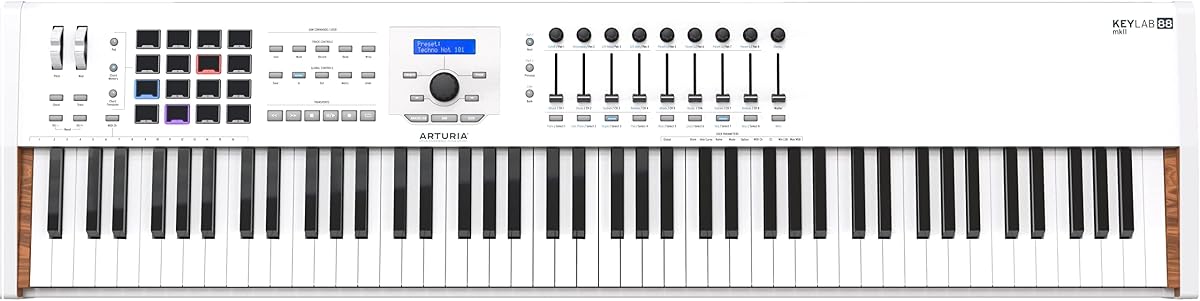
The Arturia KeyLab 88 mk3 in white provides the same robust performance as the black version but with a distinct aesthetic. It offers a 3.8 rating with users appreciating its solid build quality and key action. This model maintains the fully weighted hammer-action keys for a realistic playing feel.
We may earn a commission when you buy through this link, at no additional cost to you.
It includes 12 pressure-sensitive performance pads that respond to velocity and pressure for detailed control. The USB-C power connection simplifies setup on modern systems while the sheet music stand supports composition tasks. This version is ideal for studios with a specific design theme.
Like other premium models it carries a higher price and weight which may deter budget-conscious buyers. The white finish also requires more care to keep looking pristine in a dusty environment. These factors are manageable for those prioritizing design and performance.
Music producers looking for a controller that matches their studio decor will appreciate this white variant. It delivers professional-grade control without compromising on tactile feedback or integration features. Consider this option if aesthetics and performance are both high priorities for your setup.
Fully weighted hammer action keys deliver the touch sensitivity needed for expressive performances.
USB-C power ensures efficient energy transfer and compatibility with contemporary computer ports.
We may earn a commission when you buy through this link, at no additional cost to you.
The Studiologic SL88 MK2 is designed for producers who need deep customization and control over their sound. It holds a 4.5 rating among users who value its onboard display and encoder layout. This controller stands out for its ability to manage complex parameters without a computer.
We may earn a commission when you buy through this link, at no additional cost to you.
Its weighted keys provide a balanced feel that suits both piano and synth performances. The onboard display allows for quick adjustments of settings and parameters during sessions. Additionally it supports Numa player compatibility which expands its functionality for live setups.
The menu system can be complex for new users requiring time to master all features. It also lacks drum pads which may limit its appeal for beat makers who rely on finger drumming. These limitations are acceptable for those prioritizing control and sound depth.
Producers who work heavily with synthesis and require detailed parameter access will find this controller ideal. It supports a workflow that relies on direct control over sound shaping. Consider this model if you need a controller that adapts to your specific needs.
An onboard display allows you to navigate settings and parameters without touching your computer.
7 encoders provide detailed access to modulation and effects parameters during performance.
We may earn a commission when you buy through this link, at no additional cost to you.
The YAMAHA P71 delivers a high-quality acoustic piano feel that resonates with pianists focused on sound. It holds a 4.7 rating due to its authentic weighted action and excellent tone. While designed as a digital piano it functions effectively as a MIDI input device.
We may earn a commission when you buy through this link, at no additional cost to you.
It features 88 weighted action keys that replicate the resistance of a real grand piano. The elevated sound voices include rich piano tones that enhance practice and recording sessions. This unit includes a sustain pedal and power supply which makes it ready to use immediately.
As a digital piano it offers limited MIDI control features compared to dedicated controllers. There are no assignable knobs or faders which restricts integration with virtual instruments beyond basic note input. These trade-offs are minor for those prioritizing key feel over control surface.
Pianists who need a reliable input device for their home studio will find this model highly satisfying. It bridges the gap between practice instrument and recording tool with ease. Consider this option if authentic piano touch is your primary requirement.
Touch-sensitive keys replicate the resistance of an acoustic piano for expressive performances.
Dual Mode lets you blend two voices like piano and strings for richer textures.
We may earn a commission when you buy through this link, at no additional cost to you.
The Arturia KeyLab Essential mk3 offers a comprehensive package with extensive software included for production. It holds a 4.4 rating among users who value the included Analog Lab Pro and loop subscriptions. This controller simplifies entry into production with powerful tools ready to use.
We may earn a commission when you buy through this link, at no additional cost to you.
It features 88 hybrid synth-piano feel keys that provide a comfortable balance for various styles. The 2.5 inch LCD screen provides real-time feedback on parameter adjustments during performance. Scale and Chord modes make composition intuitive for those who want to bypass complex theory.
The key action is lighter than fully weighted models which may disappoint pianists seeking resistance. Some software features rely on subscription access which could affect long-term usage costs. These factors are acceptable given the breadth of included production tools.
Beginners and producers who want a one-stop solution will find this controller highly effective. It reduces the need for external plugins and offers immediate creative freedom. Consider this model if you want to start producing music with minimal barriers.
Includes Analog Lab Pro and multiple pianos to start producing immediately without extra cost.
Scale and Chord modes help you trigger complex harmonies easily during songwriting.
We may earn a commission when you buy through this link, at no additional cost to you.
The Arturia KeyLab 88 MkII offers a robust professional-grade controller with a classic yet reliable design. It holds a 4.6 rating among users who appreciate its Fatar TP/100LR keybed for consistent performance. This model provides a full control surface for detailed sound shaping.
We may earn a commission when you buy through this link, at no additional cost to you.
It includes 16 RGB performance pads that support drum programming and clip triggering. The layout features 9 faders and knobs which allow precise management of virtual instruments. Analog Lab V software is included to give immediate access to a vast sound library.
The controller is heavier than modern slim designs which impacts travel and small studio use. It also represents a previous generation which may lack some newer connectivity options. These are minor drawbacks for those prioritizing tactile control and value.
Producers needing a comprehensive control surface without buying separate mixing gear will find this ideal. It offers extensive control options that streamline the production process. Consider this model if you want a classic professional controller with deep integration.
The Fatar TP/100LR keybed delivers reliable hammer action for accurate dynamic expression.
9 faders and knobs provide tactile control over mixing and synthesis parameters.
We may earn a commission when you buy through this link, at no additional cost to you.
The Roland A-88MKII is built for durability and future-proofing with a strong focus on longevity. It holds a 3.8 rating as it is designed for users who value high-end materials and advanced features. This controller uses wood and premium components for a sturdy construction.
We may earn a commission when you buy through this link, at no additional cost to you.
Its PHA-4 keyboard provides unmatched playability that rivals top studio pianos. It is also MIDI 2.0 ready which ensures compatibility with upcoming technologies. The thin design allows it to fit neatly under monitors in crowded studio environments.
The premium build increases the overall price which might not suit budget-limited buyers. Customizing features requires using a control application which can be time-consuming for simple setups. These factors are acceptable for those seeking a long-term professional investment.
Studio professionals looking for a durable and future-ready controller will appreciate this model. It combines tactile quality with technological foresight to support evolving production needs. Consider this option if you prioritize build quality and longevity in your gear.
Constructed with wood and premium materials for years of dependable performance and durability.
MIDI 2.0 readiness ensures compatibility with next-generation instruments and software protocols.
We may earn a commission when you buy through this link, at no additional cost to you.
The M-AUDIO Hammer 88 Pro is designed for producers using Native Instruments with a focus on seamless control. It holds a 3.9 rating among users who appreciate the specific Native Kontrol Standard integration. This controller delivers a traditional piano feel with robust control features.
We may earn a commission when you buy through this link, at no additional cost to you.
It features 88 graded hammer weighted keys with aftertouch to support nuanced playing. The layout includes 16 RGB backlit pads for beat production and sound triggering. Additionally it offers 9 assignable faders for detailed control over plugins and DAW parameters.
The weight of the unit makes transport more difficult compared to lighter options. Native Kontrol integration is exclusive to Native Instruments which limits compatibility for other software ecosystems. These trade-offs are relevant depending on your primary software workflow.
Native Instruments users looking for deep integration will find this controller highly rewarding. It combines a quality piano feel with specialized controls that simplify preset management. Consider this model if you rely heavily on Native Instruments for your production.
Native Kontrol Standard integration lets you browse and control presets directly from the keyboard.
88 graded hammer weighted keys provide a traditional piano feel for authentic performance.
We may earn a commission when you buy through this link, at no additional cost to you.
Choosing the right controller involves evaluating key action, software integration, and build quality to match your specific production needs.
Key action is the most critical factor as it determines how your controller feels during performance. Weighted hammer keys mimic acoustic pianos and provide resistance for dynamic expression. Semi-weighted keys offer a lighter feel that works well for synth and electronic production.
Evaluate your primary playing style to decide between hammer action and semi-weighted options.
Seamless integration with your digital audio workstation saves significant time during production. Controllers with custom scripts or mapping tools allow direct control of parameters like volume and effects. Ensure the controller supports the specific DAW you use regularly.
Look for models that offer native control features for your preferred software environment.
Durability is essential for controllers that undergo daily use or frequent transport. Premium materials like wood or reinforced plastic extend the lifespan of the unit. Consider the weight of the controller if you move it between different locations often.
Select a build quality that balances portability with long-term reliability for your routine.
Assigning knobs and faders provide tactile control over effects and mixing without using a mouse. Controllers with more controls allow you to manage complex arrangements efficiently. Pads are valuable for producers who create beats or trigger samples during sessions.
Choose a layout that includes enough controls to support your specific workflow needs.
If you travel with your gear regularly the physical dimensions and weight of the controller matter. Thinner designs fit better under studio monitors and save desk space. Lighter units are easier to carry but may compromise on build stability.
Balance the need for mobility with the stability required for your recording sessions.
Modern controllers use USB for power and data which simplifies setup for most users. Some models offer USB-C for faster data transfer and bus power capabilities. MIDI ports are still useful for connecting to hardware synthesizers or rack gear.
Ensure the controller supports the connection types your current studio equipment requires.
Aftertouch allows you to modulate sound after a key is pressed which adds expressive depth. Monotouch affects all keys equally while polyphonic aftertouch affects individual keys. This feature is valuable for creating dynamic swells and expressive textures in tracks.
Prioritize models with aftertouch if you need nuanced control over sound parameters.
Your budget will dictate whether you choose a basic controller or a fully featured model. Entry-level units offer essential features but may lack advanced controls or durability. Higher-end models provide better build quality and deeper software integration.
Determine which features are essential versus nice-to-have to align cost with value.
To begin use connect the controller to your computer via USB or MIDI interface. Install any necessary drivers or mapping tools to enable full control within your digital audio workstation. Once connected launch your production software to confirm the controller is recognized.
Regular cleaning ensures longevity as dust can settle between keys and pads. Use a soft dry cloth to wipe surfaces and avoid liquid cleaners near sensitive electronics. Store the controller in a dry environment to prevent damage to mechanical parts.
Update firmware periodically to access new features and bug fixes from the manufacturer. Regular updates maintain compatibility with newer software versions and security protocols. Following these care steps ensures your controller remains reliable for years of creative work.
Semi-weighted keys use springs for a lighter feel suitable for synths while fully weighted keys use a hammer mechanism to mimic an acoustic piano. Fully weighted keys provide more resistance which helps with dynamic control. Semi-weighted options are often lighter and better for fast playing.
Most modern 88 key controllers use bus power through USB which means no adapter is needed. Some high-end models with many controls may require external power for full functionality. Always check the specific power requirements before purchase to ensure your setup matches.
MIDI 2.0 offers higher resolution but requires compatible interfaces and software to fully utilize its features. Many older systems still work with MIDI 2.0 controllers in legacy mode. You may need updates to your digital audio workstation to access all new capabilities.
Many controllers support iOS via Apple's Camera Adapter which connects USB to the device. Ensure your controller is bus-powered or has a dedicated iOS power mode. Not all features may be available depending on the specific app or software used.
Aftertouch adds a layer of expression by modulating sound after you press a key. It allows for dynamic swells, filter changes, or vibrato without releasing the key. This is crucial for creating expressive synth lines and realistic instrument performances.
Most modern controllers come with pre-mapped scripts for major digital audio workstations like Ableton or Logic. You can also assign controls manually through the software preferences menu. Custom scripts allow you to assign knobs and faders to specific parameters easily.
RGB backlit pads provide visual feedback on note triggers and assigned functions during performance. They help you quickly identify which pads are active without looking closely. This enhances the workflow for live performance and beat-making tasks.
A display screen provides real-time feedback on parameter changes and settings without needing a computer. It helps you navigate menus and manage zones more efficiently. This feature is valuable for complex setups where quick adjustments are necessary.
Choosing the right 88 key weighted MIDI controller depends on your workflow and key preference. The Novation Launchkey 88 offers seamless integration while the M-AUDIO Keystation provides a budget-friendly option. The Arturia KeyLab 88 mk3 delivers premium build quality for serious producers.
Prioritize key action quality if you play piano parts regularly. Control surface features are vital for those managing multiple plugins or mixing tracks directly. Matching these factors to your production needs ensures a satisfying user experience.
Verify current availability and pricing before purchasing since deals change frequently. Consider warranty terms and support services offered by the manufacturer as well. Investing time in selection now will lead to years of smooth and efficient production.