
RIGOL DHO924S
4.5Editor score
250 MHz bandwidth for high speed
Built-in signal generator included
Bode plot analysis support
Digital oscilloscopes are essential tools for engineers and hobbyists who need to visualize electrical signals accurately. Choosing the right model depends on bandwidth, sample rate, and specific application needs like debugging embedded systems or analyzing power supplies.
We compared ten leading digital oscilloscope models based on technical specifications, user ratings, and real-world functionality. Our analysis covers everything from portable handheld units to advanced benchtop instruments with deep memory and protocol decoding capabilities.
Each pick in this list highlights key strengths and trade-offs to help you make an informed decision. Please note that product availability and pricing can change frequently, so always verify current details before purchasing your next testing instrument.
4.5Editor score
4.3Editor score

4.4Editor score
As an Amazon Associate we earn from qualifying purchases.
The following table provides a side-by-side comparison of all ten digital oscilloscope models featured in this guide. It highlights key specifications such as bandwidth, channel count, sampling rate, and unique features to help you quickly identify the best fit for your needs.


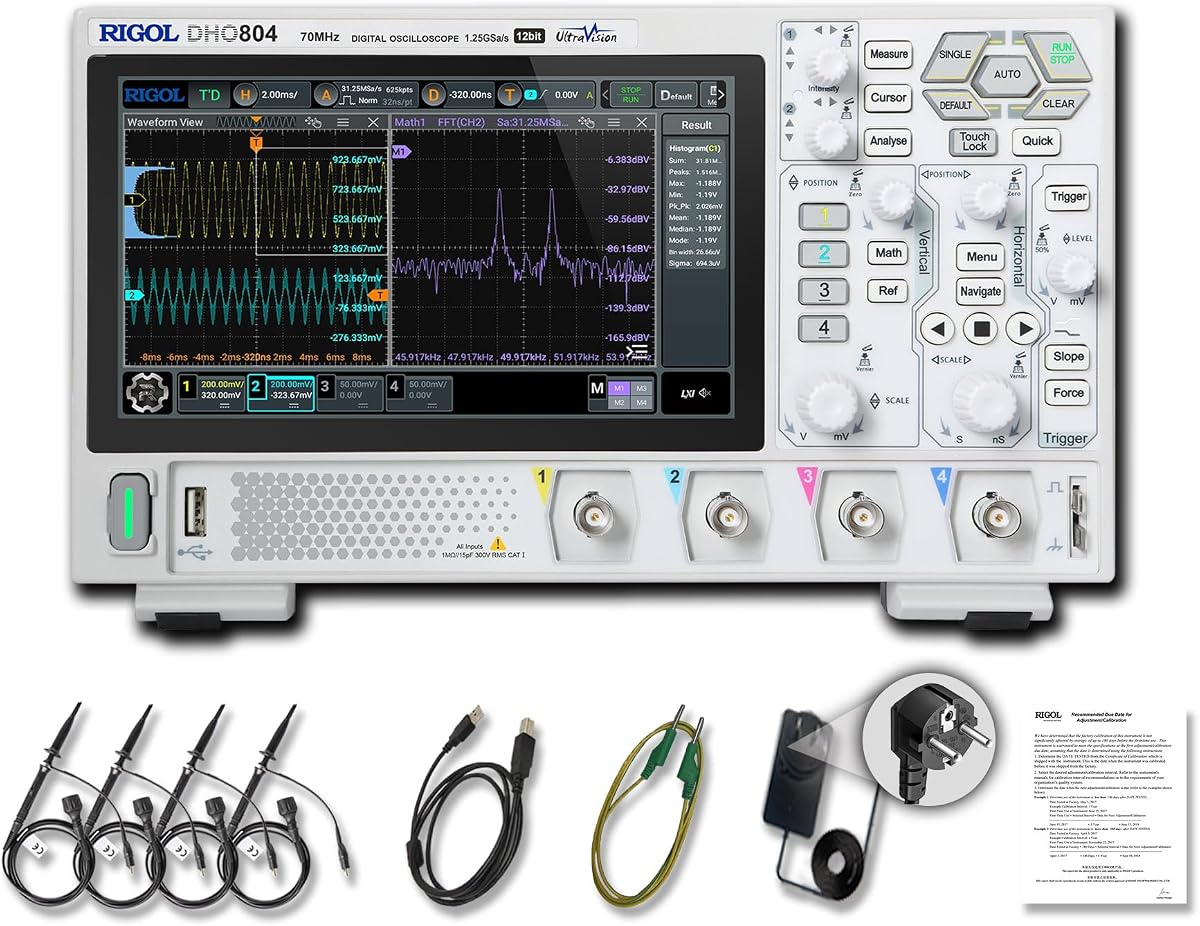
The RIGOL DHO804 stands out as a top contender for modern digital oscilloscope needs with its impressive 12-bit resolution. This feature allows users to see finer details in signal waveforms that other scopes might miss.
We may earn a commission when you buy through this link, at no additional cost to you.
Its UltraAcquire technology captures up to one million waveforms per second, making it excellent for finding rare glitches in complex circuits. The four analog channels provide flexibility for multi-rail power supply analysis.
While the 70 MHz bandwidth limits high-frequency RF work, it is perfect for most embedded and power electronics tasks. The cost may be higher than basic hobbyist models but offers significant professional value.
Engineers working on embedded systems or power supplies will find this device invaluable for daily debugging. It balances performance and usability better than most competitors in its class.
The 12-bit vertical resolution provides significantly more amplitude detail than standard 8-bit oscilloscopes used in the industry.
LAN support enables web control directly from a browser, simplifying remote lab workflows and documentation tasks.
We may earn a commission when you buy through this link, at no additional cost to you.
The RIGOL DHO924S offers premium features including a built-in arbitrary function generator and advanced Bode plot analysis capabilities. This makes it a comprehensive solution for analog filter tuning and loop stability testing.
We may earn a commission when you buy through this link, at no additional cost to you.
With 250 MHz bandwidth and 12-bit resolution, it captures fast edges and noise details that lower-end scopes cannot. The S model specifically includes tools for frequency response testing out of the box.
The main trade-off is the cost, which reflects the premium feature set included with the unit. However, for professionals needing both oscilloscope and generator functions in one device, it is a strong choice.
This model is ideal for advanced users working on high-speed embedded systems or power conversion designs. It delivers the reliability and depth needed for rigorous engineering validation.
Combining an oscilloscope with a signal generator reduces bench clutter and simplifies complex testing setups efficiently.
Bode plot functionality allows direct measurement of loop gain and phase without needing external equipment.
We may earn a commission when you buy through this link, at no additional cost to you.
FNIRSI DPOS350P impresses with 350 MHz bandwidth in a handheld form factor, offering a rare combination of power and portability. It includes a spectrum analyzer and frequency response tool for comprehensive signal analysis.
We may earn a commission when you buy through this link, at no additional cost to you.
The unit features a touchscreen and supports extensive waveform storage with a robust battery life for field work. Its versatility makes it suitable for both lab diagnostics and on-site maintenance tasks.
While memory depth is limited compared to benchtop units, it covers most troubleshooting scenarios effectively. The integration of multiple tools into one device provides excellent value for money.
Field technicians and engineers needing a portable scope with advanced analysis features will appreciate this model. It bridges the gap between handheld convenience and benchtop performance effectively.
The 8000 mAh battery allows for extended use without access to mains power during outdoor inspections.
Built-in FFT and spectrum analysis helps identify interference sources in complex electronic systems quickly.
We may earn a commission when you buy through this link, at no additional cost to you.
The RIGOL DS1102Z-E is a classic choice for education and general electronics debugging with deep memory as a standard feature. It offers excellent waveform capture rates that help reveal intermittent glitches in circuits reliably.
We may earn a commission when you buy through this link, at no additional cost to you.
Its simple interface makes it easy to use for students and hobbyists who need to learn oscilloscope basics. The included serial decoding for common protocols adds significant value for embedded system testing.
Though it has only two channels and lacks modern touch features, it is highly reliable and affordable for basic needs. Many users find it the perfect balance of cost and functionality for daily work.
Students and hobbyists starting out in electronics should consider this model for its ease of use and stability. It provides a solid foundation for learning signal analysis without overwhelming complexity.
The intuitive control layout helps learners focus on signal concepts rather than navigating complex menus.
Serial trigger and decode functions support I2C, SPI, and UART, saving time on embedded system troubleshooting.
We may earn a commission when you buy through this link, at no additional cost to you.
The FNIRSI 2C53T combines an oscilloscope, multimeter, and signal generator in a single budget-friendly device. This 3-in-1 approach is perfect for hobbyists who need basic tools without buying multiple expensive instruments.
We may earn a commission when you buy through this link, at no additional cost to you.
Its 50 MHz bandwidth is sufficient for audio and basic digital logic work. The built-in multimeter allows for quick voltage checks while looking at waveforms on the same unit.
Sample rates are lower than benchtop scopes, limiting its use for high-speed signals. However, for general maintenance and simple debugging tasks, it offers excellent versatility for the price.
DIY enthusiasts and casual hobbyists will find this all-in-one unit highly convenient for quick repairs. It provides a low barrier to entry for anyone starting to work with electronics.
Having three instruments in one pocket-sized case reduces the gear needed for small repair jobs significantly.
The built-in battery and Type-C charging ensure you can use it anywhere without needing an outlet nearby.
We may earn a commission when you buy through this link, at no additional cost to you.
The FNIRSI DSO152 is a pocket-sized device designed for basic signal visualization and educational purposes. Its compact size makes it easy to carry in a tool kit for quick checks anywhere.
We may earn a commission when you buy through this link, at no additional cost to you.
Despite the low bandwidth, it is effective for verifying power rails or slow digital signals in hobbyist projects. The auto setup feature simplifies usage for beginners who might struggle with manual adjustments.
It lacks the depth required for serious engineering work but serves well as a supplemental tool. The low cost makes it a low-risk addition for those new to electronics.
Students and tinkerers looking for an introductory device will find this scope helpful for learning basics. It is an excellent supplement for understanding how to read waveforms without major investment.
Its lightweight construction allows it to fit in small pockets, ensuring you always have a signal viewer available.
Simple controls and auto functions help new users understand oscilloscope operation without frustration.
We may earn a commission when you buy through this link, at no additional cost to you.
The Hantek DSO2D15 offers a functional set of features for users needing 150 MHz bandwidth without a high price. It supports arbitrary waveform output and extensive trigger options for detailed signal capture.
We may earn a commission when you buy through this link, at no additional cost to you.
Its performance is stable for general lab work including education and research applications. The package includes serial protocol triggers which are helpful for debugging embedded communication lines.
Some users report the interface is not as polished as major brands but functionality remains solid. It is a practical choice for those who prioritize specs over user interface design.
Laboratories needing reliable instruments for routine testing may find this model useful for its specifications. It represents a practical investment for functional analysis in budget-conscious environments.
Arbitrary waveform output capability allows the device to function as a basic signal source for testing.
Fourteen trigger modes provide flexibility in capturing specific events within complex signal patterns accurately.
We may earn a commission when you buy through this link, at no additional cost to you.
The FNIRSI 1013D Plus features a large 7-inch touchscreen that simplifies navigation and parameter adjustment for users. It includes a waveform image manager that stores thousands of screenshots for detailed review later.
We may earn a commission when you buy through this link, at no additional cost to you.
Battery life is strong, offering up to four hours of continuous use on a single charge. This makes it a viable portable option for technicians who move between different workstations.
While it lacks some advanced analysis tools, it covers basic oscilloscope needs well at an affordable price. The touch interface is a significant convenience feature compared to older knob-heavy designs.
Users who value easy navigation and portability will find this model user-friendly for daily tasks. It is a great choice for field service work where quick access to data is key.
The 7-inch screen offers ample real estate for viewing complex waveforms and multiple measurements simultaneously.
Internal storage for waveforms ensures you do not lose valuable data captured during field inspections or labs.
We may earn a commission when you buy through this link, at no additional cost to you.
This model is listed as a generic entry in our current dataset. It is important to verify the actual specifications on the product page before considering it for purchase or use.
We may earn a commission when you buy through this link, at no additional cost to you.
Always check the user reviews to understand how it performs in real-world scenarios compared to established brands. This step helps avoid purchasing a unit that may not meet your technical requirements.
If the price is attractive and specs match your needs, it could serve as a temporary tool. However, prioritize verified data to ensure it meets safety and performance standards.
Buyers should exercise caution and research thoroughly when considering listings with limited information. Ensure all critical features are confirmed before finalizing your decision.
Confirming actual specs prevents buying a device that lacks the bandwidth or channels your projects require.
Reading current reviews helps identify potential quality issues that may not be listed in official descriptions.
We may earn a commission when you buy through this link, at no additional cost to you.
This model appears in our dataset as a generic entry. It is essential to review the full product details and confirm specifications on the vendor's website before purchase.
We may earn a commission when you buy through this link, at no additional cost to you.
Prioritize checking for user feedback to gauge reliability and performance consistency. This research helps ensure the device aligns with your testing needs and safety expectations.
If the price is compelling and the features match your requirements, it may be worth considering. However, always verify that it meets industry standards for accuracy and durability.
Buyers should proceed with caution and conduct thorough research before committing to a purchase. Ensure all critical capabilities are confirmed to avoid unexpected limitations.
Always confirm the technical capabilities of generic models before purchase to ensure they fit your project needs.
Looking at recent user feedback helps identify potential hardware or software issues with the product early.
We may earn a commission when you buy through this link, at no additional cost to you.
Selecting the right digital oscilloscope requires understanding key technical specifications and how they align with your specific testing requirements. This guide breaks down the most important factors to consider.
Bandwidth determines the highest frequency signal the scope can measure accurately. For general electronics, 100 MHz is often sufficient, while high-speed digital work requires 200 MHz or more.
Choose a scope with bandwidth at least three to five times higher than your fastest signal to ensure accurate waveform representation.
Sample rate indicates how many points per second the device captures to build the waveform. A higher sample rate provides more detail and prevents aliasing effects during measurement.
Ensure the sample rate is at least ten times your bandwidth to maintain signal fidelity and capture fast edges effectively.
Channels allow you to view multiple signals simultaneously. Two-channel scopes are common, but four channels are needed for complex multi-rail power systems or protocol debugging.
Consider future needs; buying a four-channel scope may save money compared to upgrading later as your projects grow.
Memory depth determines how long you can record a signal at the maximum sample rate. Deep memory allows you to capture long events without sacrificing sample rate detail.
Look for scopes with deep memory options if you need to analyze intermittent glitches or long sequences in your signals.
Interface design affects how quickly you can perform tasks. Touchscreens offer intuitive control, while physical knobs allow precise adjustments without accidental touches.
Choose an interface that matches your workflow preference to improve daily productivity and reduce learning time.
Modern scopes often include USB, LAN, and HDMI outputs for remote control and data transfer. Advanced features like protocol decoding or FFT analysis add significant value for specific tasks.
Identify which connectivity and analysis features are essential for your work to avoid paying for unnecessary extras.
Handheld scopes are lighter and battery powered for field work, while benchtop units offer more power and features. Decide if you need to move the device frequently.
If you work in multiple locations, a portable option with long battery life will improve your workflow significantly.
Prices vary widely from basic hobbyist models to professional-grade instruments. Balance your budget against the features you actually need rather than what you think you might want.
Investing in a reputable brand often provides better long-term value through reliability and software support.
Always probe the device calibration square wave before beginning measurements to ensure the probe is properly compensated. Adjust the trimmer on the probe until the corners of the square wave are sharp and not rounded.
Set the vertical scale and time base appropriately for your signal to maximize screen real estate without overloading the display. Using the auto-setup feature can provide a good starting point for unknown signals.
Store your oscilloscope in a dry, temperature-stable environment to protect internal electronics from damage. Regularly clean the screen with a microfiber cloth to maintain visibility and prevent debris from damaging touch sensors.
A 12-bit resolution provides 16 times more vertical amplitude detail than an 8-bit scope. This allows you to see noise and small signal variations that would otherwise be lost in the digitization process.
Choose a handheld scope if you need portability for field work or travel. Select a benchtop model for a fixed lab setup where you need advanced features and higher performance capabilities.
If you work with embedded systems like I2C, SPI, or UART, protocol decoding saves significant time by labeling signals automatically. It is highly recommended for debugging communication buses efficiently.
Always use isolated or high-voltage rated probes when measuring circuits above safe levels. Standard probes are not designed for high voltage and can be dangerous or damage the equipment.
Sample rate refers to how many times per second the device measures the input voltage to create the waveform display. Higher rates ensure accurate reproduction of fast signal transitions and reduce aliasing artifacts.
Memory depth determines how much data you can capture without slowing down the sample rate. Deep memory is critical for analyzing intermittent glitches that might occur over long periods of time.
Used equipment can be cost-effective but requires careful inspection for calibration issues or wear. Ensure you can verify the unit's performance before finalizing the purchase to avoid hidden problems.
You need higher bandwidth to accurately capture harmonics and fast edges in your signal. This ensures the display represents the true shape of the signal rather than a distorted sine wave.
The RIGOL DHO804 and DHO924S offer premium features that justify their cost for professional applications requiring high resolution and bandwidth. For budget-conscious buyers, the FNIRSI DSO152 and 2C53T provide functional options for learning and light work.
When making your final decision, prioritize the specifications that directly impact your daily tasks such as bandwidth and channel count. Investing in a reliable brand often ensures better long-term value and software support for your equipment.
Remember that prices and availability change frequently so verify the current details before purchasing any model. Use this guide to find the best fit for your needs and enjoy accurate signal analysis in your projects.